
How to reconcile a cash advance step by step
Confirm the purpose and responsible person
Start with one defined cash advance, project activity, procurement task or temporary budget.
Record the starting balance
Enter the funds already available when the book begins.
Add later funds as Money In
Record top-ups or additional funds as transactions so the timing is visible.
Enter every expense as Money Out
Include the date, description, category, amount and supporting-document status.
Review the transaction register
Resolve missing categories, invalid amounts and undocumented exceptions before closeout.
Calculate and count
Calculate the expected balance, then count the actual remaining cash independently.
Document the result and close
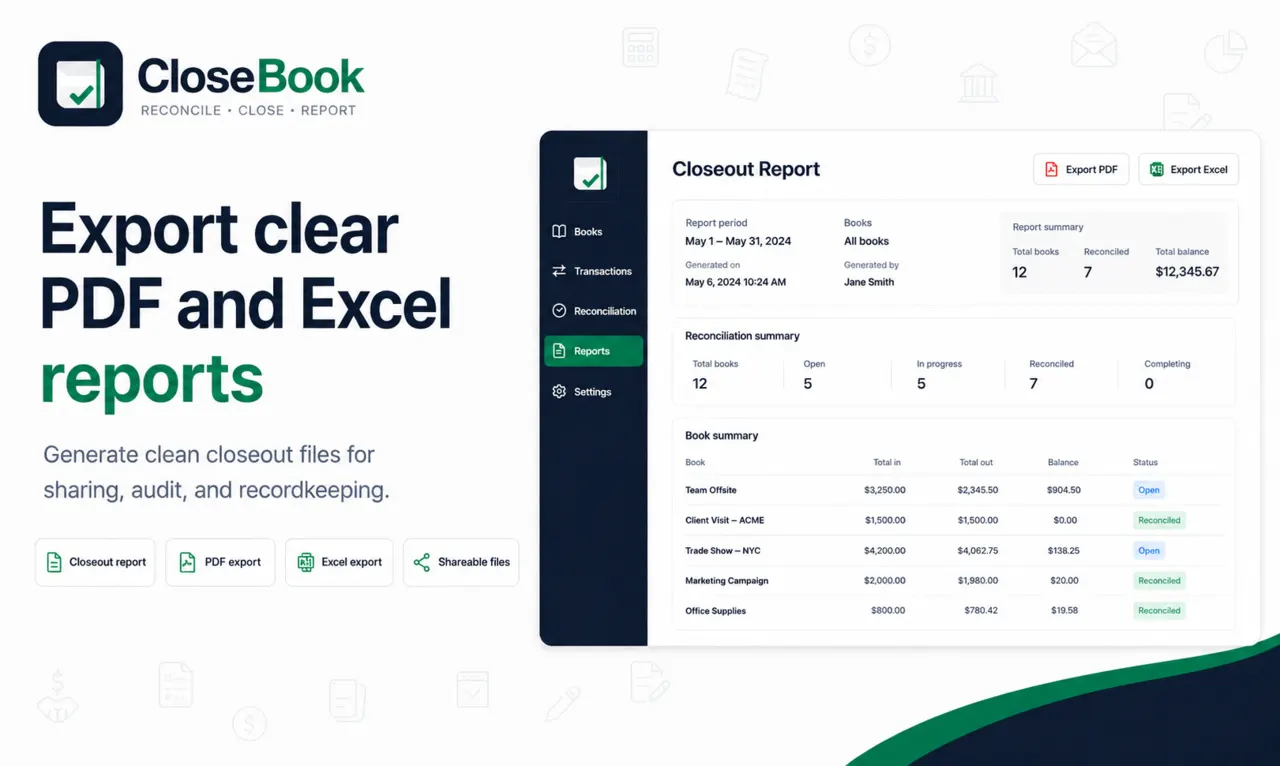
Explain a shortage or surplus, close the book and export the closeout record.
Numerical example
Worked example
Cash count
The expected balance is $2,250.00 minus $1,830.00, which equals $420.00. The actual remaining cash is $405.00. The difference is therefore −$15.00.
Balanced, shortage and surplus examples
| Expected | Actual | Difference | Status |
|---|---|---|---|
| $420.00 | $420.00 | $0.00 | Balanced |
| $420.00 | $405.00 | −$15.00 | Shortage |
| $420.00 | $432.00 | +$12.00 | Surplus |
How to handle missing receipts
Do not silently treat a missing receipt as complete documentation. Record the expense, select the appropriate documentation exception, explain why the original evidence is unavailable and attach or reference alternative evidence outside CloseBook when your organization requires it. Read the missing receipt handling guide for a structured process.
Final closeout check
- The title and responsible person are correct.
- All Money In and Money Out transactions are recorded.
- The expected balance matches the transaction calculation.
- The actual balance was counted at close.
- The difference direction is interpreted correctly.
- Shortages, surpluses and document exceptions are explained.
- The final report is retained according to local policy.